Showing posts with label News. Show all posts

Friday, March 16, 2018

These Beer Bottles got their 3D Printing Makeover done and it’s Cool.

If your weekends are always spent partying either at home chilling or at a pub and Beer is your favorite drink along with a passion for 3D Printing.When you go to a bar you order your drinks maybe soft drinks or hard drinks, get high and enjoy the moments.But do you ever notice the bottles, each one is different, the packaging, the labels, brands and also the prices.

You just comment “Huh, neat” grab the drink and enjoy getting high, after all only what is inside the bottle matters.Few people realize just how much work goes into packaging redesign, or how it actually does impact the buyer, even on a subliminal level. Many big teams of designers work to get a new look which is just perfect, while the manufacturer evaluates the costs and decides if a change is worth it.

Rather than throwing away the bottles and adding up to the pollution, you can take a step to revolutionize things and this article will tell you exactly how you can.We have bought a good news for you, so get excited.

The Australian Beer that recently underwent bottle makeover is James Boag’s.  The makers of the bottle were thinking about getting a makeover done but also thought whether it would be worth the money. They didn’t want to make a change just because they could; the new design decided would have to be attractive enough to be well-received by customers. They were hoping to make this determination before significant time and money were spent on the redesign.

The packaging company Orora, that supplies James Boag’s bottles, it decided to go for 3D Printing prototype for the The organization contacted 3D Systems On Demand Manufacturing, which went up against the challenge of making a 3D printed bottle with an indistinguishable clearness and tone from glass, and also the same close by heave.new bottle.Using SLA 3D printing technology and VisiJet SL Clear resin, 3D Systems 3D printed four prototypes, countering the disparities in weight by adjusting the interior wall thickness of the design file based on the density of the resin. They also carefully color-matched to get the same green as the original bottles.

Subsequent to being 3D printed, the bottles experienced an in-house completing protocol that included wet and dry sanding and the application of a surface tint and last clear coat. As per Tracy Beard, General Manager for the On Demand Manufacturing office in Lawrenceburg, Tennessee, a large number of clear parts are delivered each week in that office alone.

It took just seven days for the models to be finished, and soon thereafter they were furnished with labels and caps and loaded with fluid. They were then placed in a shop for observing, and criticism demonstrated that the new plan was a hit, giving the James Boag’s group the certainty to proceed with the full overhaul.
Thus the Boag’s  Company did a makeover of their Beer Bottles with help of 3D Printing so now you can also have a 3D Printed bottle as an aesthetic in your house.Thus you even don’t throw the bottle and keep it with you.

Get set started with 3D printing right away with your own 3D Printer which will help to get the best from 3D Printing. Explore your vision in the new era of 3D Printing with Geeetech.

Credits:3ders.org.

Friday, February 9, 2018

DIY!! 3D Printed Ergonomic Keyboards for the Uncompromising Typist…

If you are a mechanical geek you surely might be having insights about the  Reddit Mechanical Keyboard community.

Yeah, a whole community just talking, making and sharing their split keyboards!! Now the question that arises is why do we need a mechanical keyboard? Most manufacturers make keyboards from one circuit board and use what many describe as mushy buttons. A mechanical keyboard uses individual switches on each key and many people claim it is not only much more satisfying to type but also more accurate and faster.

But mechanical keyboards are not much common but there is a community which loves making their own keyboard. Some people get kits and assemble them together or all the parts and fix them properly and some 3D Print the framework and attach the required electronics. When it comes to customizing the keyboards, DIY works the best and so here are the Keyboard you can print them out.

Dactyl Keyboard

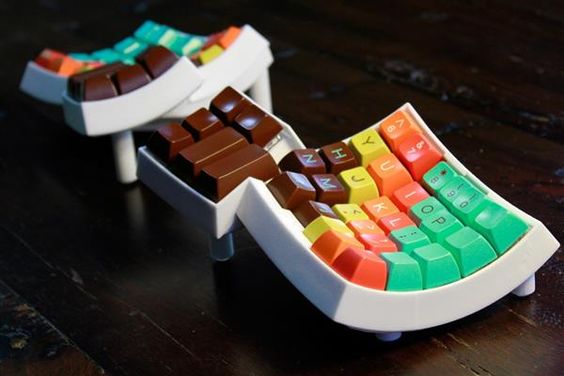
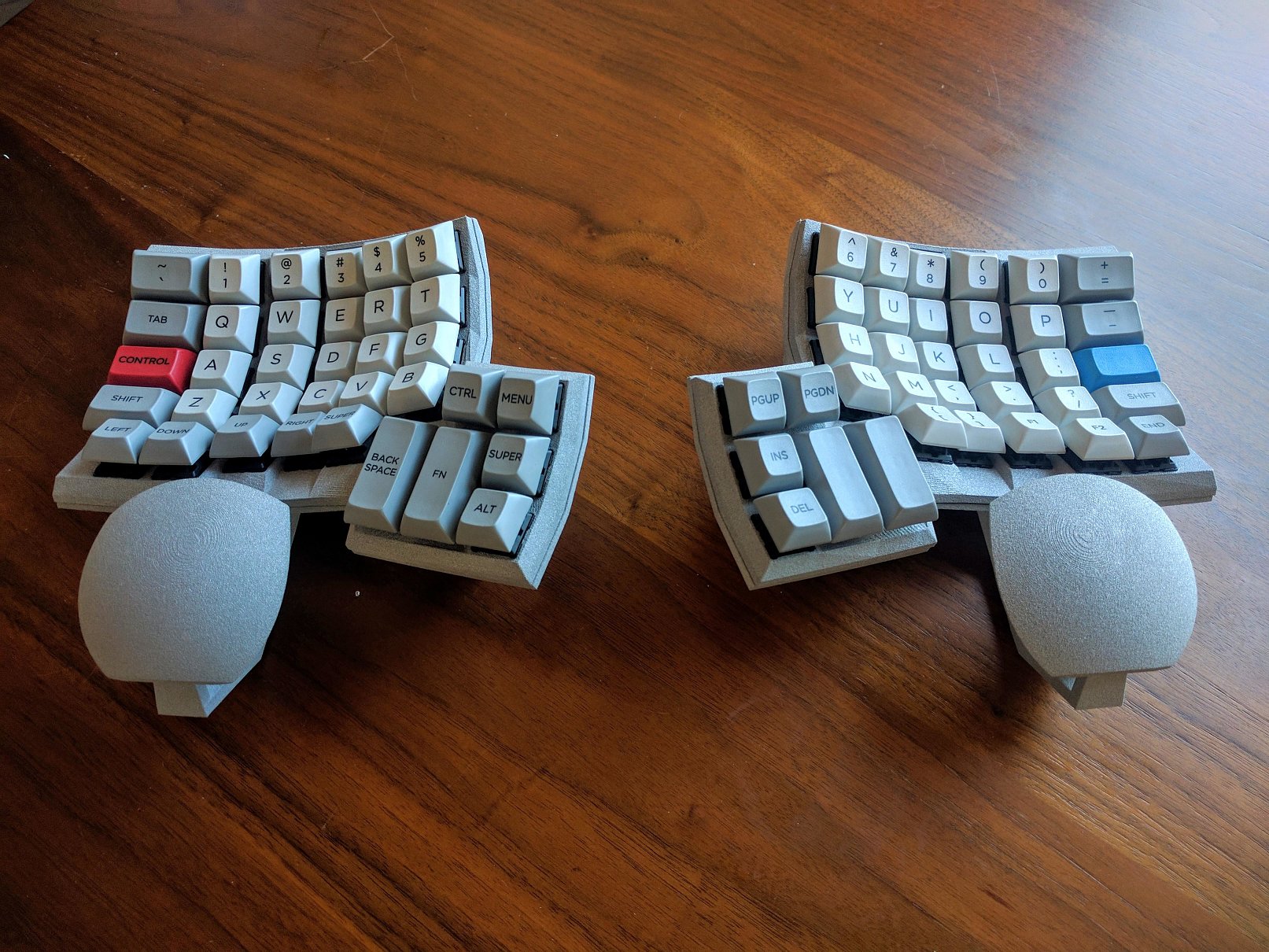
The Dactyl keyboard contains two distinctly curved keyboard segments, it sounds a little weird and is a little weird but Dactyl Keyboards are future.Dactyl, the name itself refers to an object curved to fit the natural shape of the hand, so it’s almost like an optimized version of an ergonomic keyboard.

The Developer of the keyboard is Matt Adereth, he is a tool and infrastructure builder and a mad keyboard collector.Now the good thing is it’s also a mechanical keyboard.Over the decades you might have noticed the clicking sounds and physical satisfaction has been decreased, that’s because the IBM type classic keyboards have phased out, instead, we are all using less expensive, spill-proof keyboards packed with rubber membranes that do all the work for us.

The Dactyl keyboard is inspired from the  Kinesis Advantage. “The layout is very similar [to that of the Kinesis Advantage] and quite comfortable. I’ve got the thumb cluster a little closer and angled and I think it makes it nicer. The only problem right now is the lack of palm rest, which some ergonomics folks think is actually a good thing. I’m working on one next,” he tells his fans.If you’re interested, you can actually build one of these amazing keyboards yourself with the help of Matt’s GitHub files, but there isn’t really a detailed guide available. And the best printer and PCB for printing this keyboard is available at Geeetech.

Keyboardio

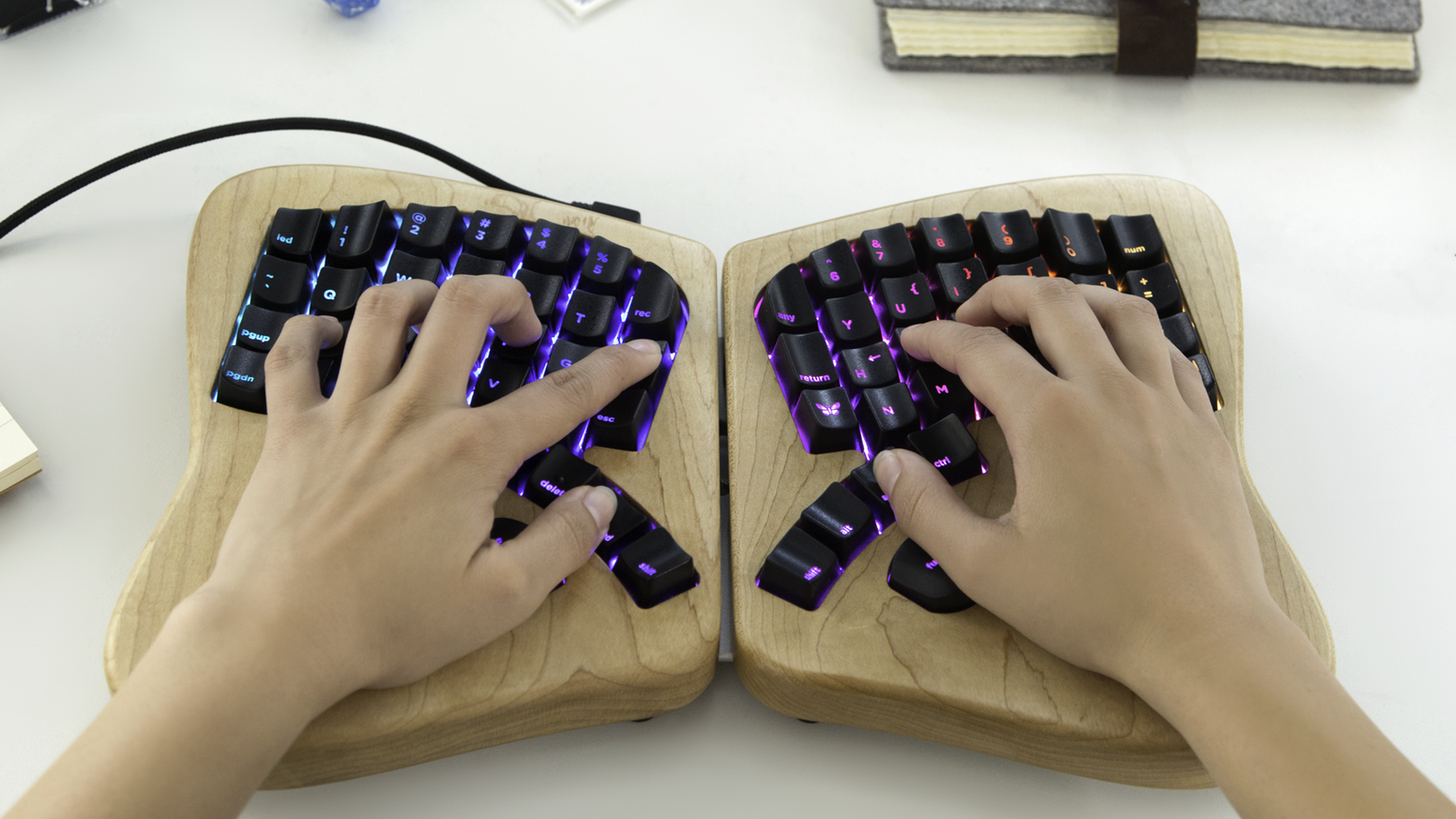
If you are an uncompromising typist and spend most of the hours on the computer then this is just the right keyboard for you.It is one of the heavier keyboards in the list which is made of wood and adds a character to your keyboard.It ages gracefully without looking dirty and a slob.

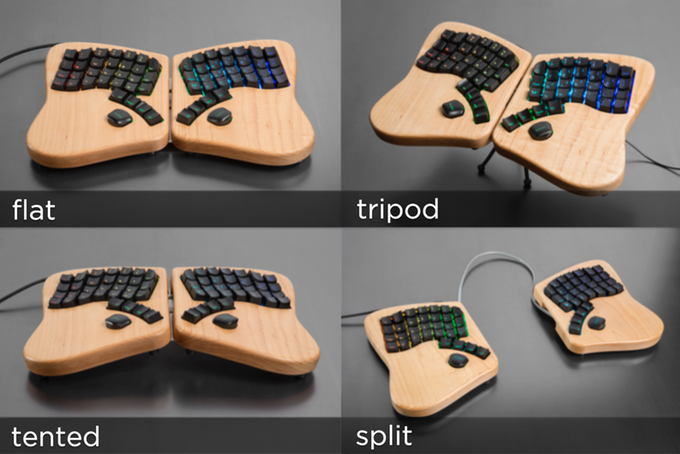
The company mills the Model 01’s enclosure from two blocks of solid maple and use mechanical keyswitches similar to those found in the original Apple II. The keycaps are all custom sculpted, the 64 keycaps make fingers guide to the right key.The base keyboard can be laid flat, split, tented, or setup tripod style.

Other features include fully programmable LEDs, true N-key rollover (NKRO) which is for folks that need to press more than 6 keys at once, and application-specific macros.The high-quality keyswitches make the soul of the keyboard lively. Get to know more about Keyboardio and print it out by yourself.

Mitosis Keyboard

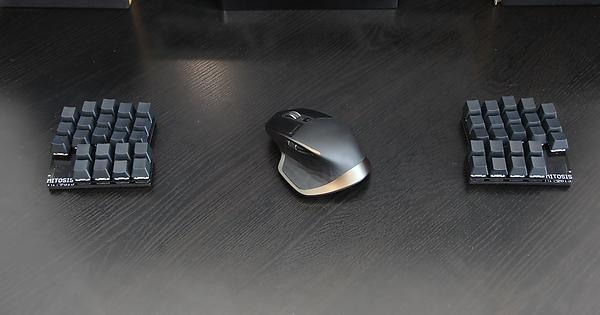
A wireless split ergonomic keyboard which you can totally do it yourself.The designer has posted up the source and design files on this Reddit thread including PCB manufacturing files, Lasercutting files, Wireless firmware, QMK source, PDF Schematics, PCB design files and Parts list with suppliers. The creator says learning to make a DIY keyboard is a bit difficult but it was a bit simple.

Thumb clusters were the part of his plan but used to get pinky pain after long typing sessions. The benefit of a completely different system is that he could still touch type QWERTY, something in his brain just switches right back when touches a row staggered keyboard.

Shortcut Ergonomic Gaming Keyboard

A fully customized keyboard for all the gaming freaks out there.The main features of this keyboard are Thumb cluster,hand-shaped design, split keyboard, and a configurable layout. Know more about the keyboard on their blog.

These keyboards might have convinced you to start making one yourself, so what are you waiting for? Just get the right printer that will satisfy all your needs and the right PCB and other accessories required and start printing. We suggest you the Geeetech Prusa I3 will be the best for printing a user-friendly and elegant keyboard.

Credits: Reddit.com,allthingsergo.com,youtube.com, shortcut.gg.

Sunday, January 28, 2018

This is the world’s first 3D Printed toilet made specially for India!

You’ve definitely heard of houses being 3D printed thanks to the latest concrete 3d printers that can even print a brand new house in 24 hours! But did you know that 3D printed toilets are soon to be a reality too?

It’s hard to believe that something as common as a toilet which is a necessity in our daily lives, is not so common in the lives of millions living in India. Many that do not have access to toilets even end up using public areas. Toilet scarcity is a national problem in India affecting more than half of India’s population and even resulting in deaths due to unhygienic conditions.

Luckily, Hamilton Labs, based in Singapore, is developing 3D printable toilets to help improve poor sanitary conditions in India. Using Hamilton’s robotic HamilBot Mark 1 3D printer, India is about to see a brand new change that could potentially save many lives and drastically improve the quality of life.

Scarcity of toilets in India

Being the second most populated country the world, India’s poor sanitation, and hygiene problems are definitely distressing. About 524 million people do not have access to local toilets, defecate in the open which further leads to diseases and deaths as the cycle goes on.

In order to change the current situation, the government has undertaken a pledge to make India an open defecation free country by 2019. But to make this dream a reality, construction of over 100 million toilets across the nation need to be funded. And though, around 60 million new toilets have been built, 40 million more are still needed.

The main reason why there aren’t sufficient toilets is that these regions are severely lacking in trained craftsmen who can construct the required toilets as well as low funding. Since Hamilton’s 3D printed toilets are much more affordable, India could see a big change.

Hamilton Labs lends a helping hand

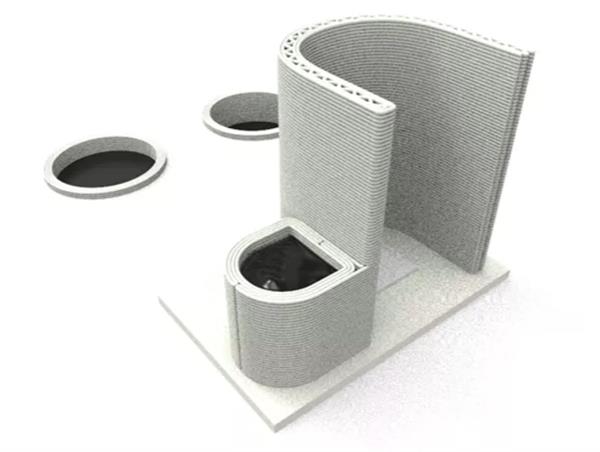
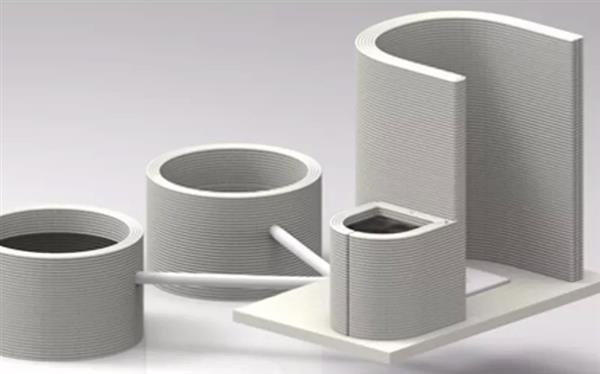
Having signed an agreement with India’s Center for Rural Information and Action (CRIA) Hamilton plans to use one of its robotic 3D printing systems to build 3D printed concrete toilets in Bihar, Northern and Eastern India. Known as the HamilBot Mark 1, this robotic 3D printer will be used to build toilets that are comfortable, quick to print and beautiful to look at.


Working with Singapore’s National Additive Manufacturing Innovation Cluster (NAMIC), a collaborative 3D printing scheme organized by Nanyang Technological University (NTU), the National University of Singapore (NUS), and the Singapore University of Technology and Design (SUTD), Singapore’s Hamilton Labs could be about to contribute massively to India’s sanitary project.

The 3D Printed Toilets

If you’re wondering what these 3D printed toilets will be made from- it’s definitely not your average PLA and ABS. A special cement made from recycled fly ash, which is a product of coal combustion will be used. This fly ash is abundantly available in countries that use coal-fired power plants like India.

Hamilton’s HamilBot Mark 1 3D printer which is powered by a robotic arm, is a large-scale 3D printer. Take a look at the printer in action:

HamilBot Mark 1 is capable of working 24/7 with theoretically minimal manual input. That cuts down not only cost but also the timing to construct these toilets, were it to be done by manual labour! The project to build these toilets in India is expected to start soon, with the robotic cement 3D printer expected to arrive at its destination later this month!

Its awe-inspiring to see such advancements in the 3D printing industry adnd we’re so ecited to see what’s in store for the future. Could there be a day where every single thing around is 3dprinted?? Well we’ll have to wait and see to find out!

Credits: 3ders.org, youtube.com

Saturday, January 13, 2018

See what happens when 3D Printing meets the world of fashion!

We’ve seen 3D Printing do a lot of amazing things! From printing houses to printing implants for a surgery, 3D Printing continues to amaze us till date. So why should it come as a surprise that 3D Printing is creating big waves in the fashion industry?

By merging fashion with the latest 3D printing technology, these designers have created some of the most spectacular fashion pieces that may soon make its way into your wardrobe!

Don’t believe us? Take a look!

Futuristic Dresses  by Anouk Wipprecht

What do you get when 3D Printing fashion meets robotic technology? The incredible creations of Anouk Wipprecht! Check out this 3D printed dress designed by her which uses robotic spider arms to defend the wearer! Powered by Intel, the dress has multiple sensors that monitor the wearers breathing and stress levels. If the wearer is approached aggressively, the sensors read that she feels threatened so, in response, the robotic arms of the dress will extend to defend her.

Another one of her innovative designs is the “Synapse Dress”  which reads the wearers emotions and even lights up. The interactive dress itself is printed using a flexible material named Thermoplastic Polyurethane (TPU)and can pick up signals from all over the wearer’s body. It is equipped with an EKG, as well as a proximity sensor, a camera, and a series of LED lights capable of 120 watts of brightness.

Similar to the spider dress, the proximity sensors tell if the wearer feels uncomfortable or threatened, making the dress light up.

It doesn’t stop there! Anouk even designed an interactive Smoke Dress that lets out a stream of smoke when someone gets too close!

Crystallization Collection by Iris van Herp

Designed by Iris van Herpen in collaboration with Daniel Widrig the “Crystallization” collection will always be remembered as the first collection during which a 3D printed piece appeared on a fashion runway. Inspired by the transformation of water turning into crystal, Iris named her collection just that.

Many of her eye-catching pieces were made with the help of 3D printed pieces carefully designed and sculpted to showcase her ideas. The designs are innovative and extremely intricate, yet at the same time stiff.

To many, Iris van Herpen is one of the most mind-blowing Dutch designers out there that really creates ‘wearable’ art and she even creates dresses for Lady Gaga.

FilaFlex Material Collection by Danit Peleg

Looking for something more casual? What if you could print yourself a dress at home without having to run around to find the perfect piece? That’s exactly what Danit Peleg was thinking when she created these dresses! But it took her a long time to find the perfect filament that would be flexible and comfortable.

Luckily she discovered FilaFlex which was much more pliable than the normal plastic and joined all the pieces together to create her signature collection.

With the help of FilaFlex, Danit has experimented with many pieces to create lace-like textures that she could work with similar to how other designers work with cloth fabric. Her dresses take around 400 hours to print depending on the intricacy but she loves the challenge!

Dita von Teese Dress  by Francis Bitonti & Michael Schmidt

This stunning body-hugging dress was 3D printed for burlesque dancer Dita Von Teese using her exact dimensions. Designed by Francis Bitonti and Michael Schmidt using the Fibonacci sequence, the dress was 3D printed in Nylon by Shapeways.

Printed straight from a computer, the flexible “fabric” is made with layer upon layer of fine powdered nylon within the preheated chamber, with input from the CAD file. The end result is a fabric that is flexible enough to move and expand with every movement, giving a feminine and sensual touch to the wearer.

Furthermore, the gown was assembled from 17 printed pieces that were hand-linked into the dress and then dyed black and polished. The dress is even adorned with over 13,000 Swarovski crystals which make all the more glamorous.

Hard Copy Collection by Noa Raviv

Meet Noa Raviv, an Israeli designer who uses 3D printed embellishments to create breathtaking fashion statements. She was even awarded Fashion Designer of the Year at the 3D Printshow in 2014 and it is clear to see why.

The asymmetrical silhouettes seen in her work are inspired by Greek architecture and created from multiple ribbed layers of polymer. These polymers are carefully distorted using various CAD tools and the results are mind-blowing.

With the help of 3D printing, she creates grid-like patterns that are warped and stretched over the garments to create optical illusions across the body. These embellishments snake over the shoulders and cover the chests of the dresses.

Biomimicry collection

Fashion designers threeASFOUR and Travis Fitch together with Stratasys created 2 revolutionary dresses named ‘Pangolin’ and ‘Harmonograph’ which were 3D Printed using a new textile. The dresses are much more flexible than conventional 3D printing plastics and allow the wearer to move about freely.

The collection named ‘Biomimicry’ gets its inspiration from nature, plant geometry and animal anatomy which is evident in the dress ‘Pangolin’ named after the animal itself. The designers used a special nano-enhanced elastomeric 3D printing material which gives the material its fluidity and makes it flexible.

Credits: pinterest.com, designbloom.com, weburbanist.com, wired.com, shapeways.com, iq.intel.com

Monday, January 8, 2018

Now You Can 3D Print Your Thoughts Into Reality!!

All actions result from thoughts, so it is thoughts that matter.

What could be more beautiful than giving life to your thoughts and printing them out? Doesn’t that sound cool?

The traditional way of 3d printing is changing drastically and this vast industry has a lot to offer.Every day there is a new technique that is transforming this industry and similarly, there is too much of competition going on. The 3D printed thoughts are the new innovation and is gaining popularity recently.

So basically, 3D printing your thoughts is printing out anything that you think. It is all related to your thought process and these brainwaves are transmitted to the printer via sensors resulting into the design that you want.

The first ever object developed by  3D printing thoughts is the monster hand.This garish orange piece of plastic, small enough to hold in the palm of a hand, could pass for a missing limb of a toy Tyrannosaurus. It is appealing just for two reasons, firstly it’s a 3d printed  and secondly, it is printed via thoughts.

Thoughts

This all started at fanfare of Santiago Makerspace, a  technology design studio in the Chilean capital. This toy limb’s shape was designed according to the designer by connecting his brainwaves to the headset and then transferring the neurological signals to the PC. It was invented by George Laskowsky, Chief Technical Officer of Thinker Thing, the Chilean start-up developing the mind-controlled 3D printing system.

Why 3D printed thoughts?

The traditional 3D printers are helpful only to the people who know the software well and are a pro in the industry. A beginner will be confused and also rely on downloading the designs from the internet and then printing them out. Also, the design software is not easy to master, especially if you are four-years-old and haven’t yet learned to hold a pencil properly.

“What is the point of these printers if my son cannot design his own toy?” says Bryan Salt, CEO of Thinker Thing. “I realized that while there were a lot of people talking about the hardware of the printer no-one really seemed to be talking about how to actually use it.” In theory, 3D printers could help unleash our inner creativity, freeing us from the constraints of traditional manufacturing methods. However, in practice, those unwilling or unable to plough through the software instruction manual could be left downloading ready-made models designed by others.

That’s where the software Emotional Evolutionary Design (EED)  comes into play where the thoughts are presented in some real action. Their present plan is to focus on the Monster Dreamer Project, which will allow users to design their own fantastical creatures using the power of thought. When the children will sit in front of the computer they will see different body shapes in the form of bubbles. These will mutate randomly, with built-in rules preventing them becoming too abstract. The children’s reactions to the changes will be picked up by an Emotiv EPOC headset, a electroencephalography (EEG) device designed to pick up the electrical signals from brain cell interactions using fourteen sensors on the scalp. As different states of the brain as excitement or boredom specific patterns of brain activity will be generated.The favoured shapes will grow bigger on the screen, while the others shrink. The biggest shapes are combined to generate a body part, and the process is repeated for different body parts until the monster is complete. The final result should be a unique 3D model that is ready for printing as a solid object.

FUTURISTIC THOUGHTS

Second Nature

A design featured by emotional response is rather based on the thought of critiquing more than thinking to. make one from scratch. “One of the biggest bottlenecks right now with 3D printing is content,” says Professor Hod Lipson, director of the Creative Machines Lab at Cornell University, in Ithaca, New York State. “We have iPods with no music. We have machines that can make almost anything but we do not have a lot of things to make with them.”

Lipson’s Lab is also working to create 3D objects from the mind. Two Lipson’s students have developed a website     EndlessForms which mimics nature’s way of creating new designs in small steps. In the start of this process, there are 15 3dimensional shapes presented, from which the person needs to choose 2shapes. Then after combining these two shapes more 15 shapes will be available. Thus the proper combination of shapes can give you the desired design.

If you wanted to make a cat, you might click on one shape with the semblance of a muzzle and another with two pointed, ear-like triangles on top. The computer would then offer up a series of new shapes that more closely resemble the cat you have in mind, and so on until the model reaches the desired shape. This was taking a long time so the Lipson’s decided to use the Thinker Thing idea, but the issue with headsets is that when you tend to think about a particular state for a long time i.e. happiness it tends to result in sweat also if the headsets are of poor quality the wrong signals get transmitted. Some sceptics argue that consumer EEG devices are not really measuring thoughts at all.

With some of the limitations of consumer EEG technology in mind, Lipson and colleagues decided to monitor thoughts via the eyeballs. Eye tracking can identify the shapes that get the most attention, and this could be used to shape design processes. The snag is that without an EEG headset it is not possible to tell whether someone is looking at a shape because they find it strange or beautiful. Even so, the team’s research so far suggests that at the end of the process participants still feel they have managed to reach the desired design. There’s some way to go, but in the future, a combination of brain scanning and eye tracking may be preferred to the trusty old mouse when it comes to 3D object design.

Dream Maker

Imagine your dreams getting into reality just by the help of 3D printing. A Japanese scientist led by Yukiyasu Kamitani, of the ATR Computational Neuroscience Laboratories in Kyoto, revealed they had made significant steps towards automated dream decoding. Three people had there brain scanned by an MRI, they were awakened when EEG signals indicated they had reached an early phase of sleep associated with dreaming. Researchers asked them to describe their dreams.Kamitani’s group then chose 20 categories of objects and scenes based on the words that occurred most frequently in the descriptions. Then they listed out the categories on the basis of frequently imaging objects thus decoding the dreams.  Thus now we can even decode the dreams and print them and know about the future dreams this 3D printing is making impossible things possible.

So what are you guys waiting for? Get involved with the future techniques by buying a 3D printer by Geeetech right here and give life to your dreams.

Credits: bbc.com,designboom.com

This Company is Making 3D Printed Houses For the Homeless!

Every metropolitan city is plagued with the problem of homelessness and New York is no stranger to this. You’ll find more than 61,000 sleeping in the city’s homeless shelters every night and countless others on the streets and subways amongst other public places. The reason? The increasing rents and demand for luxury apartments have forced thousands of people to the streets. But thankfully that’s where FramLab comes in!

Merging design and creativity, FramLab is a creative agency that’s dedicated to solving world problems and building a better future. And to tackle the problem of homelessness, FramLab has proposed its project Homed- 3D Printed hexagonal pods to serve as shelter for the homeless.

Since New York doesn’t have much room for building these pods, Framlab came up with something extremely innovative. They began looking for empty space and found it in what it calls “vertical lots,” i.e. the sides of established buildings.

The sides of those buildings, without windows or doors, will be the blank sidewalls to which  FramLab will attach the pods. And yes they look just like a honeycomb structure. Aesthetic and functional, these pods will provide a versatile space and provide a single room occupancy.

THE 3D PRINTED PODS

Made of steel and oxidized aluminum, each pod will be equivalent to a compact room with suitable interiors. PMMA smart glass on the front face of the modules will offer great views out to the city and when they are clustered together it will form a screen for art installations or adverts.

The 3D printed interior, covered in wood laminate, can be constructed to incorporate things like furniture and lighting, so that very little is needed to be brought in from outside. The pods will have furniture, equipment, and cabinets alongside the wooden interior for a soft and friendly atmosphere that is efficient and clean; wellness modules in the structure include sanitary provisions between the occupants.

And how do you enter these pods?

Attached to every pod will be a scaffolding staircase erected on the side of the building, making them secure yet easily movable if needed. They’ll also be attached to each other, creating small communities.

Featuring private interiors adorned with all the furniture an autonomous individual would need, the design seeks to offer elements “which are crucial for acceptable qualities of life: privacy, safety, individuality, self-esteem, among others,” according to the project’s website.

And it doesn’t stop there- Homed units are designed so that each pod can be disassembled in one place and reassembled in another in a matter of days. Each group of units can be reconfigured upon over time or moved to entirely new areas of the city as its landscape evolves.

The materials used in construction are proposed to be able to withstand weather conditions. For an ever-changing and evolving urban landscape, the modules will be easily transportable and can be assembled and dissembled in a few days.

3D Printing And Building New Dreams

3D printing has proved to be a major boon in all fields of life from medical science to architecture. It allows incredible flexibility and which turn your creative dreams into a reality. A lot that we once perceived to be fantasy and impossible is now coming to fruition right before our eyes with the help of 3D Printing.

Homed is yet another example of achieving the unthinkable! Although Framlab makes it clear that this isn’t meant to be a permanent solution, it’s a wonderful alternative nevertheless. Hopefully, this concept will spread to other major countries that will provide housing options for the homeless.

All in all, 3D Printing shows us that constructing functional homes doesn’t always have to be slow and costly. 

Credits: dezeen.com, archdaily.com, 3dprintingmedia.network, inhabitat.com, framlab.com

Saturday, December 30, 2017

3D Printing in 2018? Here’s what we can expect for the year to come!

The advancements in 3D printing in the year 2017 have truly amazed us so its safe to say we can expect a lot more in the year to come! Prepare to be blown away and take a look at some of the projects already in process. Here are some of the cool things we can expect in 2018!

Customizable Printing Materials

Almost everything that can be printed in 3D can also be personalized. With the help of 3d printing, doctors and medical experts are already creating bone replacements which are fully customized for each patient. Apart from this, experts are already experimenting with 3D printing using Graphene, a flexible and transparent substance, stronger than steel.

Markforged, a Boston-based company, has just released new Composite 3D printing technology which prints tools and manufacturing parts with incredible strength. Fully functioning metal parts can be printed in under 24 hours with their new Metal X 3D printing system. The tool promises to save money and time, especially for the manufacturing industry.

Nano-Printing

Nano-printing involves the printing of particles invisible to the naked eye. These particles, which are only a few atoms thick, could possibly transform electronics as we know them. These tiny printed particles are currently being tested to produce powerful batteries, and provide further processing power for devices.

Along with this, nano-printing is also in telescopes and microscopes to increase the optic power. According to Nanowerk.com, “these nanosensors can enhance the microscopes’ sensitivity and detection speed by miniaturizing their detection component up to 100 times”.

Smart Robotic Arms

In Belgium, students are in the process of creating a robotic arm which will be able to interpret and translate sign language. The birth of the idea came to be as a result of the small number of sign language translators available in the world.  Thus far, the machine can take text and translate it into fingerspelling. The project still has a long way to go, but could significantly impact the hearing-impaired community.

3D Printing in Nuclear Industry- First 3D printed nuclear reactor fuel part by 2018

Power company Westinghouse plans to be the first to install a 3D printed fuel part in a commercial nuclear reactor by Fall 2018. The current plans are to install a thimble plugging device, made of AM 316L stainless steel and non-AM 304, in a commercial reactor. With support from the U.S Department of Energy, this 3D printing milestone will soon be a reality and it is currently in the process of researching various different additive manufacturing processes.

3D printed steel bridge in Amsterdam

MX3D, a robotic additive manufacturing company based in Amsterdam, is set to complete printing its steel bridge by June, next year. The bridge is already 1/3 complete and has been designed by Joris Laarman and funded by Autodesk.

What distinguishes this technology from traditional 3D printing methods is the application of the ‘printing outside the box’ principle. The printing is done by 6-axis robot arms, which means you are no longer restricted to a square box in which everything takes place.

4D Printing

We were only beginning to wrap our heads around 3D printing and now we hear that 4D printing has arrived to take it further. What is 4D Printing, you ask? It is generally considered a part of 3D printing, however, 4D printed materials will be able to adapt to their environments and transform after they have been constructed. This programmable matter can react to outside factors like environment, head, humidity, etc.

All in all 2018 is sure to bring us a lot of surprises and we can’t wait. And if you still down own a 3D Printing and are afraid of missing out, don’t worry! Just take a look at some of our Best 3D Printers and get printing!

Credits- 3ders.org, 3dprintingstocks.com, oddstuffmagazine.com, hackaday.com, eteknix.com

Thursday, December 28, 2017

Take a look at the most amazing 3D Printed Cars in the World!

In the movie Back to the Future there were flying cars and other amazing stuff, today our cars still do stick to the ground, however, when the movie was made, in 1985, most of the materials in modern vehicles didn’t exist.Thus it was a future prediction. No one might have thought that a simple machine like Printer would 3D Print a big object like a car, this too was just an idea then which has come into reality. Thus the saying anything is possible if you are willing to make it possible is 100% true its just that it might take time.3D printing is advancing the automotive industry and making vehicles stronger and lighter.

Below are the most fascinating 3D Printed cars existing in the world:

3D PRINTED BUS: OLLI

Starting with a surprise, this is no 3D printed car but a BUS. Manufactured by Local Motors, it is named as “Olli” and is the most intelligent Bus which uses  IBM Watson’s “Watson Internet of Things for Automotive”. Olli is a driverless electric and a smart Bus.The brain of the 3D printed bus, IBM Watson is a cognitive learning platform that analyzes all sorts of data for Olli. Using natural language recognition, the 3D printed bus will understand and answer passengers’ questions about the bus, technology, or the area.The bus can carry almost 12 people.

Olli is successfully running on the road and is also being purchased.Miami-Dade County in the US is looking into a pilot program in a similar vein and Las Vegas has two  Olli’s already.The 3D Printed Car Manufacturer of Olli is  Local Motors, the 3D Printing Technology is Polyjet.

Strati

Strati was basically created by Local Motors, an open source think tank for mobility, design and engineering. The main reasons behind developing Strati was reducing the number of parts used and investment cost for production.The car was manufactured in just 44 hours, A number of non-3D printed parts feature, such as wheels, battery and the like, but — looking at the picture above — the Strati’s bodywork is obviously 3D printed. It was just a functional concept.

Soulmate

At the 2016 Geneva Motor Show, EDAG exhibited the successor to its Light Cocoon 3D printed car idea. EDAG’s development authorities worked with Bosch architects to make a vehicle that touts progressed systems administration and lightweight outline.Unlike its predecessor, the Soulmate places a strong emphasis on the “internet of things”, glimpsing an interconnection of apps and services accessible from your car that, to be honest, we’re already beginning to see in the likes of BMW’s companion app for its i cars. It looks cool, is lightweight and the structure is 3D printed.

The manufacturer of Soulmate is EDAG, the 3D printing technology being used is SLM (Selective laser melting) , SLS (Selective laser sintering).

Light Cocoon

A German manufacturing company has been experimenting a lot with generative designs and 3D Printing. EDAG in 2015 Light Cocoon in the Geneva Motor Show, it uses lessons learned from nature to inform its design.

Its leaf-like outer skin uses Jack Wolfskin stretchy fabric to cover a topologically optimized 3D printed structure beneath. Lightweight beyond belief, this bodywork measures out at a silly 19 grams per square meter.

GENESIS

The idea behind this 3D printed car is the turtle’s protective shell. Similar to it EDAG introduced the GENESIS  which can grow naturally to a limited size and also can be reduced, this was not possible using man-made tools.Not strictly a car, as much as a conceptual direction. Using the bionic signature of a turtle’s shell for its design, German automotive engineering company EDAG’s GENESIS introduces the notion of musculoskeletal systems to passenger safety in a car.In steps added substance fabricating, taking into consideration complex geometries and a car application for turtle shell-like outlines for traveller cells and so forth. The advantage of such a procedure implies improved structures that perform honourably in crash situations.

LM3D

Local Motors had made a headline in 2014 with the mostly 3D printed Strati, many people called it as a publicity stunt.In any case, after a year the organization lifted the top on the second troublesome collection: the LM3D.

LM’s goal is to consolidate as much of the traditional bill of materials into a single, 3D printed piece. Eventually, 90% of the car could be 3D printed. The collaborative design company is continually testing new types of materials and different blends for additive manufacturing.

Shelby Cobra

Developed by a Ridge National Laboratory , this 3D printed car was printed using  Big Area Additive Manufacturing (BAAM) machine from Cincinnati Incorporated — a 3D printer capable of huge, strong and lightweight composite parts without the need for tooling.Additive manufacturing did allow the researchers while equipping the Shelby Cobra with new tech. The car is loaded with experimental technologies and is a laboratory on its own. The technology used for Shelby Cobra is FDM  and is a functional concept.

Blade

The Blade sure is a looker. Creator Divergent 3D provides a disruptive new approach to car manufacturing, incorporating 3D printed nodes connected by carbon fibre tubing into the chassis.This system results in industrial strength frame that can be assembled in a matter of minutes. Its super-strong, lightweight innards, the Blade boasts better power-to-weight ratio than current Formula 1 racing cars.Their goal is to make any 3D printed car up to 90% lighter in an industry transition they refer to as “car dematerialization”.